

Claude Monet by the Lily Pond
In the final entry of "Claude Monet: The Art of the Series," we visit Monet at his water-lily pond in Giverny.

This is the fifth and final essay in Claude Monet: The Art of the Series.
The Gazette will be on a holiday break through the end of December. Wishing you all a very merry Christmas and a happy New Year! -Nicole

As the First World War embroiled France, Georges Clemenceau made a trip to Normandy to visit his artist-friend at Giverny. The former prime minister (who would be elected to lead France once again in 1917) was concerned about Claude Monet, and he felt he had just the project to revive the painter’s spirits.
The rest of Europe was engulfed in disaster and death; the modern world had come marching into view with the sound of machine guns and the suffocation of mustard gas. The Belle Époque, the world of Impressionism, had disappeared. At Giverny, Monet was dealing with his own tragedies—his wife Alice had died in 1911, and his eldest son Jean had died in 1914. Already prone to depressive episodes, Monet sunk into a deep, impenetrable melancholy.
You may recall that several years before, Clemenceau endeavored to buy Monet’s Rouen Cathedral series for the country. Clemenceau was determined to secure some of his friend’s works for the French people, especially now that so many of the Impressionists’ artworks resided in the United States. (To which Paul Durand-Ruel would likely say, the French should have bought the art when they had the chance! It was Durand-Ruel’s idea to bring the art to the States in 1886 after poor reception in France, and this decision cemented the success of Impressionism on the global stage.)
At Giverny, Clemenceau proposed the idea of a Water Lilies series painted for the French nation. The government could even help Monet secure supplies to build a separate, larger studio on the grounds of Giverny for the project. At 24 by 12 meters (about 79 by 39 feet), the studio could only be constructed during the war thanks to Clemenceau’s connections.1



Monet painted over 250 works in his Water Lilies series, but these giant canvases required a special viewing experience. The artist conceptualized what we today might call an “infinity room,” such as those created by the contemporary artist Yayoi Kusama. Monet wanted viewers to feel as if they were inside his pond, viewing the lily pads up close. He therefore agreed to Clemenceau’s proposal, but on the condition that a special pavilion be created for the canvases’ display.
Initially, they chose a location on the grounds of the Hôtel Biron, where there already existed a museum dedicated to Rodin. The French government rejected the proposal, feeling that a pavilion constructed for Monet was too great an honor.2 (Even at this stage of his career, Monet could still experience rejection!)
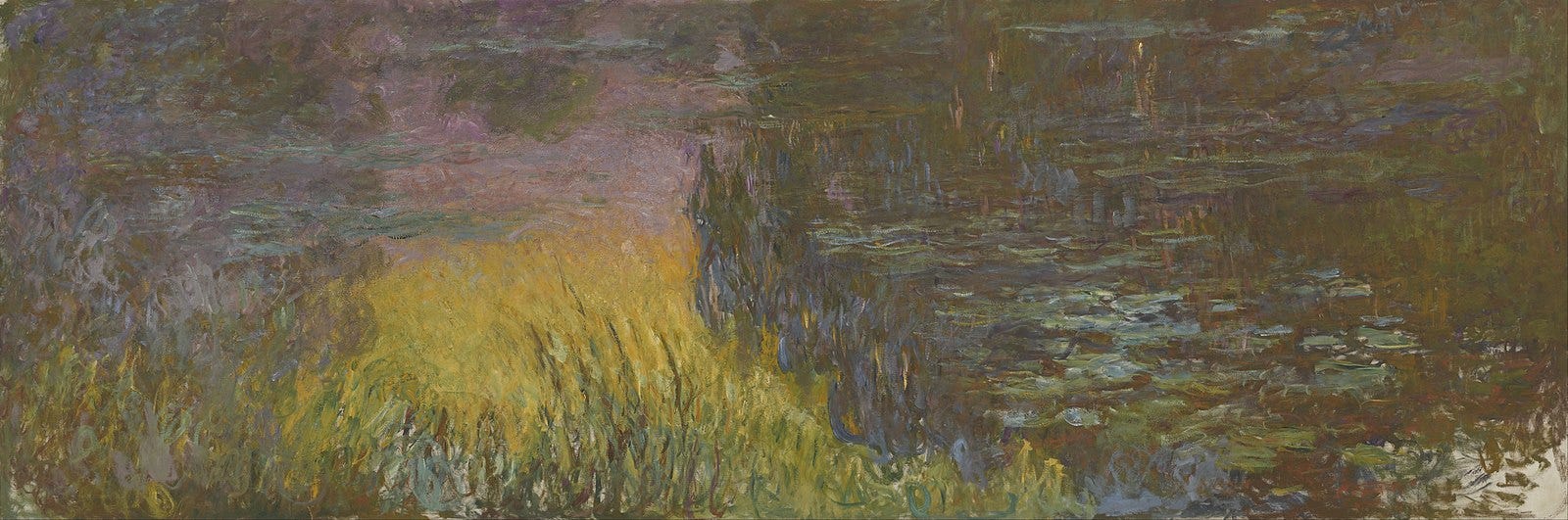

But Monet was in his seventies, and he had learned a thing or two in his time. He threatened to pull the project, and sure enough, buyers from the United States and Japan flocked to Giverny with the goal of securing the paintings for their nations’ museums. Clemenceau counter-offered with the Musée de l’Orangerie, where the wall-to-wall canvases could be installed in two oval-shaped rooms. Monet finally agreed, and to this day, thousands of visitors every year get to see Monet’s Water Lilies as he intended them to be displayed.
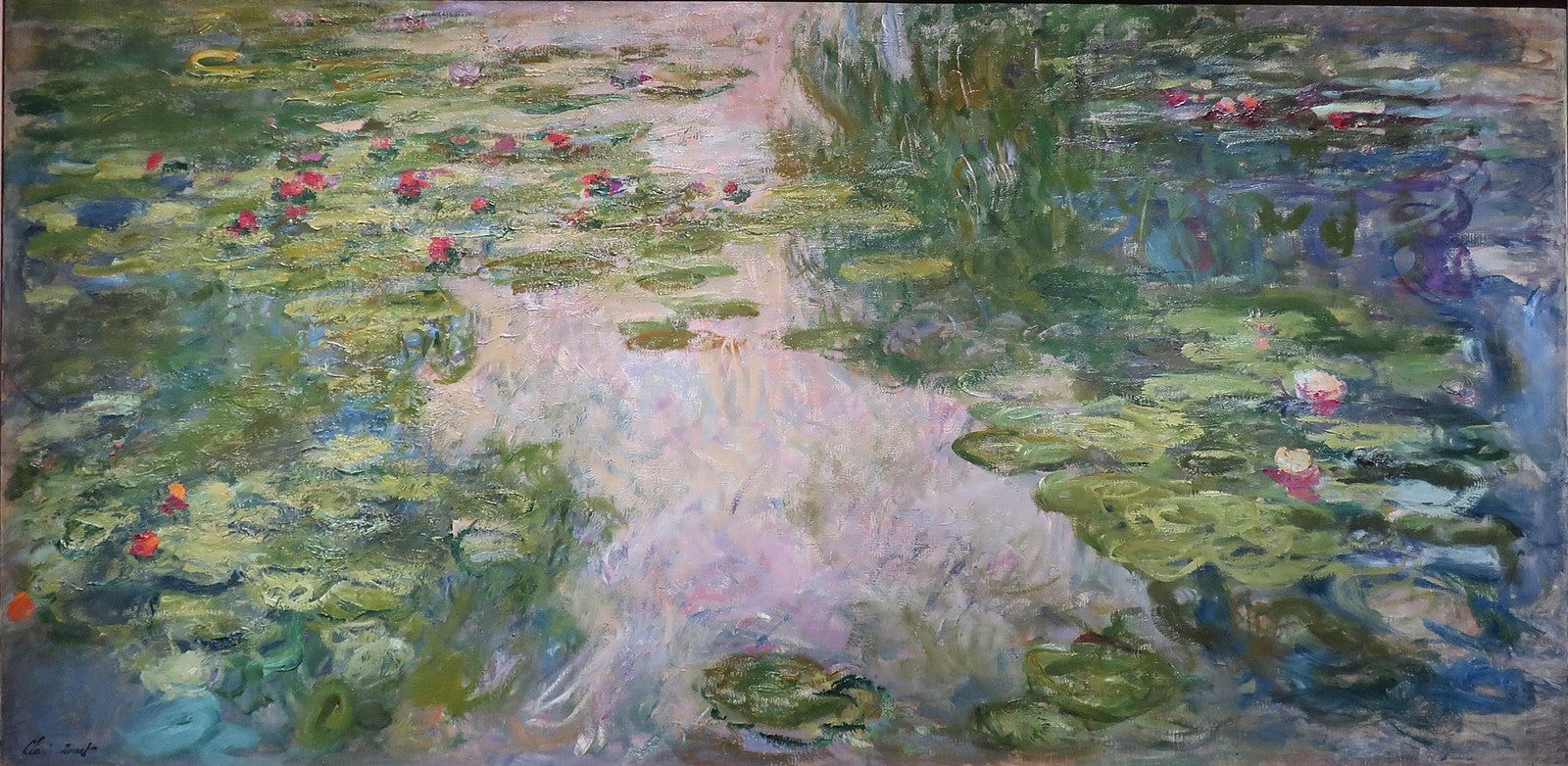
When I was twenty, I became one of those visitors. Standing in the Orangerie, I indeed felt submerged in Monet’s watery world. What struck me about the vast canvases was the sight of Monet’s garden reflected on the pond. Compared to his earliest Water Lilies, these later works completed in the last decade of the artist’s life were landscapes mirrored in water, with visions of the bank’s willows and reeds shimmering amidst the lily pads.
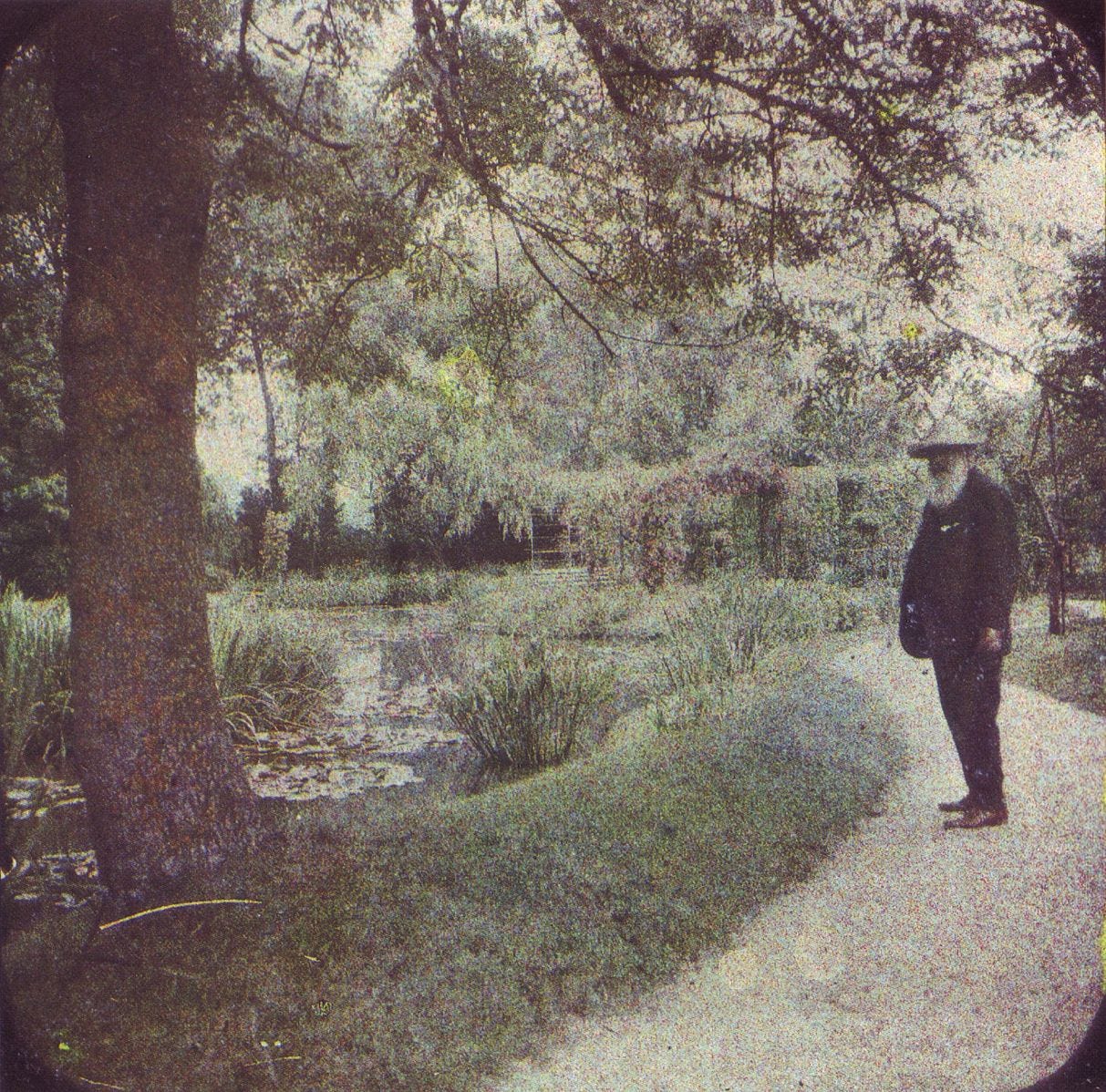
Last week, I mentioned that Monet’s brushstrokes grew more fluid in his final years, and his compositions became further immersed in the world of the pond. Monet’s declining eyesight forced him to adapt his technique; many photos of him during his later years show the artist wearing a big straw hat, which he needed to keep the sun from his eyes.
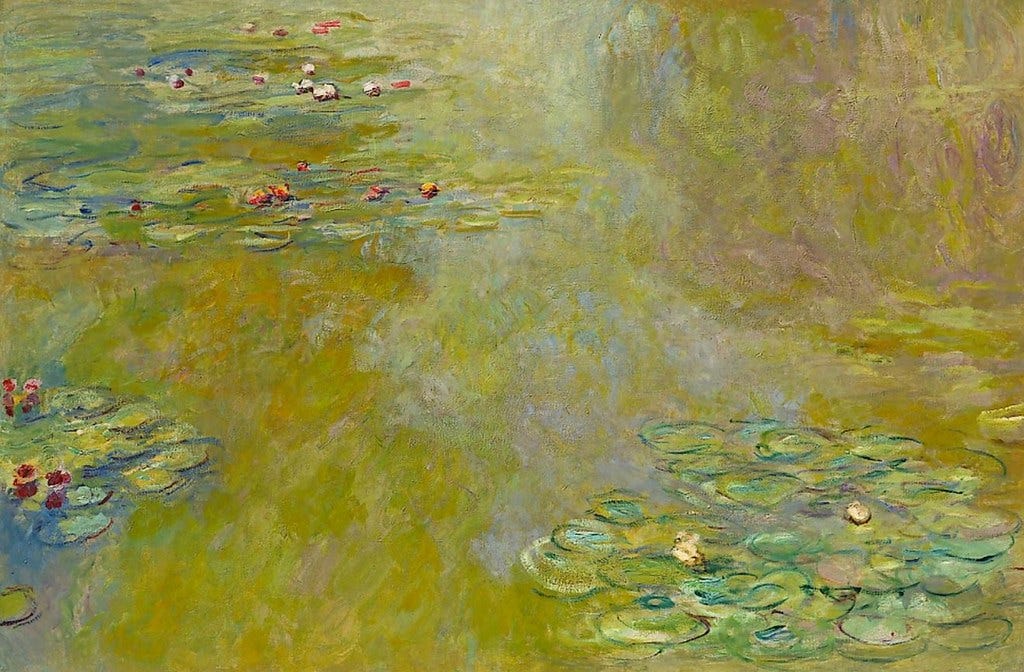

He underwent two operations to treat his cataracts. This restored his eyesight, though perhaps impacted the way he viewed color. His later works incorporate more dramatic shades, especially reds, browns, and deeper greens. Nonetheless, there’s a potent energy to these paintings that exemplify the artist’s uncompromising work ethic. He painted relentlessly until his death in 1926—he was just shy of eighty-seven years old.
The hundreds of artworks he left behind aren’t even his complete collection. Monet saw that after Édouard Manet’s death, the artist’s sketches and unfinished paintings were quickly snapped up by buyers and institutions. Monet was keen to preserve a fastidious legacy, and he burned the canvases with which he was unsatisfied.
Claude Monet was the last of the original Impressionists to pass away. At Monet’s funeral, Clemenceau ripped off the black cloth that had been draped over his friend’s coffin. “No black for Monet!” he declared, replacing it with a floral fabric.3 The garden followed Monet into the afterlife.
Some artists don’t live long enough to see their ideas become mainstream. Monet lived so long that he witnessed both the rise of Impressionism and the blossoming of its offshoots. He told Gustave Geffroy:
Techniques vary, art stays the same: it is a transposition of nature at once forceful and sensitive. But the new movements, in their full tide of reaction against what they call “the inconsistency of the impressionist image,” deny all this in order to construct their doctrines and preach the solidity of unified volumes.4
Perhaps Monet felt some angst about the younger generation’s abandonment of Impressionist principles. But the Post-Impressionists, the Cubists, the Surrealists, and all the others owe much to the movement that Monet and his friends pioneered. After all, they took on the artistic establishment, thereby opening the door for the innovative styles that would follow.

And, as is the nature of trend cycles, artists of future generations would once again find inspiration in Monet’s work. The Abstract Expressionists, including Mark Rothko and Jackson Pollock, were particularly intrigued by Monet’s use of color in his Water Lilies series, and they adapted his ideas for the Post-War era.
Monet is an example to all artists (and here, I’m including those from all areas, including literature, film, etc.) because he not only persevered in the face of adversity, but he dared to push his vision to the furthest possible extent. His use of the series allowed him to fully articulate the aesthetics of Impressionism across a range of subjects.
Too many today find these “pretty paintings” frivolous, but amidst the chaos and conflict of our world, the ability to recognize and elevate the beauty of nature is worth celebrating. Of all people, Monet understood that beauty—in the earliest embers of sunrise, in a mist-laden afternoon, in the pastel fantasia of dusk.
Recently on Fireside Fables - When Christmas Was For Ghosts: A Very Victorian Christmas
In Victorian England, Christmas Eve was a night for ghosts — a time when families gathered around the fire to share stories of the strange, the supernatural, and the unexplained. Why did this tradition die off, when so many other Victorian holiday customs endured?
Pour yourself a cup of tea (or maybe eggnog?) and join me for a very Victorian Christmas on Fireside Fables!
Christoph Heinrich, Monet (Taschen, 1994), 87.
Heinrich, Monet, 90.
Mary McAuliffe, Dawn of the Belle Époque: The Paris of Monet, Zola, Bernhardt, Eiffel, Debussy, Clemenceau, and Their Friends (Rowman & Littlefield, 2011), 338.
John Rewald, The History of Impressionism: Fourth, Revised Edition (Museum of Modern Art, 1973), 586.